Check out the panel discussion hosted by Philips and hear about leveraging public cloud and generative AI technology to empower the next generation of radiology. We explore how radiology informatics solutions benefit from secure, compliant cloud technology and can automatically scale to support vast amounts of imaging data. We also discuss how AI/ML and generative AI in healthcare can serve as a radiologist’s assistant to help enhance diagnostic speed and quality while supporting patient outcomes – all thanks to the public cloud.
UPDATED ---- Philips Ultrasound faced challenges that were constraining innovation and patient care delivery. On the development side, the company sought faster iteration cycles in algorithm development, while managing increasingly complex parallel processing UPDATED LINK demands that strained their traditional hardware-based architecture.
Clinically, ultrasound imaging remained highly patient-dependent with significant variability across different patients and scenarios. Healthcare providers needed more robust imaging that could adapt automatically, deliver higher-resolution 3D volumes at better frame rates and offer advanced tools for visualizing complex anatomy—particularly during interventional procedures and in women’s healthcare applications.
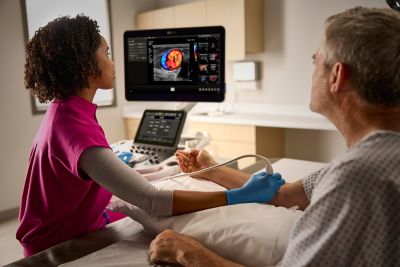
UPDATED To accelerate innovation and support increasingly advanced imaging techniques, Philips transitioned its ultrasound platform from custom FPGA-based hardware to software-defined beamforming for its third generation. Powered by NVIDIA RTX professional GPUs, this transformation delivers the high-performance, energy-efficient computing needed for real-time beamforming. The result is sharper images, faster processing and more confident diagnoses, helping clinicians deliver better care, more efficiently.
UPDATED Templates | UPDATED Validation | Status |
|---|---|---|
UPDATED Article | UPDATED Body text | Active |
UPDATED Article | UPDATED Title | Active (deleted below field value) |
UPDATED Article | UPDATED Publication |
Callout: Published - EN - US-NL-DE
1. updated EENNN GPU beamforming enhances diagnostic confidence, thereby reducing the need for clinicians to interpret ambiguous ultrasound images. Improved image quality eases the burden of difficult cases, enabling consistent exams and smoother workflows. In procedural settings, GPU-enabled systems support demanding imaging for minimally invasive interventions, expanding access and reducing costs.
Quote: Published - EN - published- US-NL-DE
CHANGED - English - Locale - It’s nothing for members of the care team without members of the care team… this is the fingerprint we’re leaving on nursing.

UPDATED SINGLE PAL - You tube : Published - EN - US-NL-DE

UPDATED SINGLE PAL - VIDEO : Published - EN - US-NL-DE

UPDATED SINGLE PAL - PDF : Published - EN - US-NL-DE
single Pal - PDF - NL - Provide a caption to this photo that ties it into the content.
UPDATED SINGLE PAL - DOCX : Published - EN - US-NL-DE
Single Pal - Doc - NL - Provide a caption to this photo that ties it into the content.
UPDATED MULTI PAL - Image : Published - EN - US-NL-DE


UPDATED MULTI PAL - Videos: Published - EN - US-NL-DE
Rollout multi video - NL-1

Rollout multi video - NL-2
UPDATED MULTI PAL - DOC: Published - EN - US-NL-DE
UPDATED MULTI PAL - Youtube: Published - EN - US-NL-DE

1 Youtube-NL-rollout-Roll

2 Youtube-NL-rollout-Roll
======================================================================================

Long description
update -Validating long description
Leaflet_IV_Example_simplifiedQR
